Forecasting nursing need
from patient care patterns
The Alberta Department of Health needed a faster, more accurate way to forecast RN and LPN demand across the province. AltaML built
a machine learning model that turns patient stay patterns into workforce projections, cutting a months-long manual process down to weeks.
63% improvement in forecasting efficiency and 4 weeks saved per year, supporting 102 forecasting requests annually.

THE CHALLENGE
Workforce planning in healthcare isn't just an HR problem. In Alberta, ensuring the right number of registered nurses and licensed practical nurses are available — in the right locations, with the right skills — requires coordinated guidance across government, health authorities, training institutions, and front-line teams.
The Alberta Department of Health needed a reliable forecast of future RN and LPN demand to support system-wide planning. But the existing process was slow.
Producing a single forecast required substantial manual effort, pulling analysts away from higher-value work and limiting how often decision-makers could get updated projections. With 102 forecasting requests a year to support, that pace wasn't sustainable.
The core question: how do you predict how many nurses the province will need, years out, with enough precision to actually guide policy?
THE SOLUTION
AltaML built a machine learning model that works from the ground up, starting with patients, not headcounts.
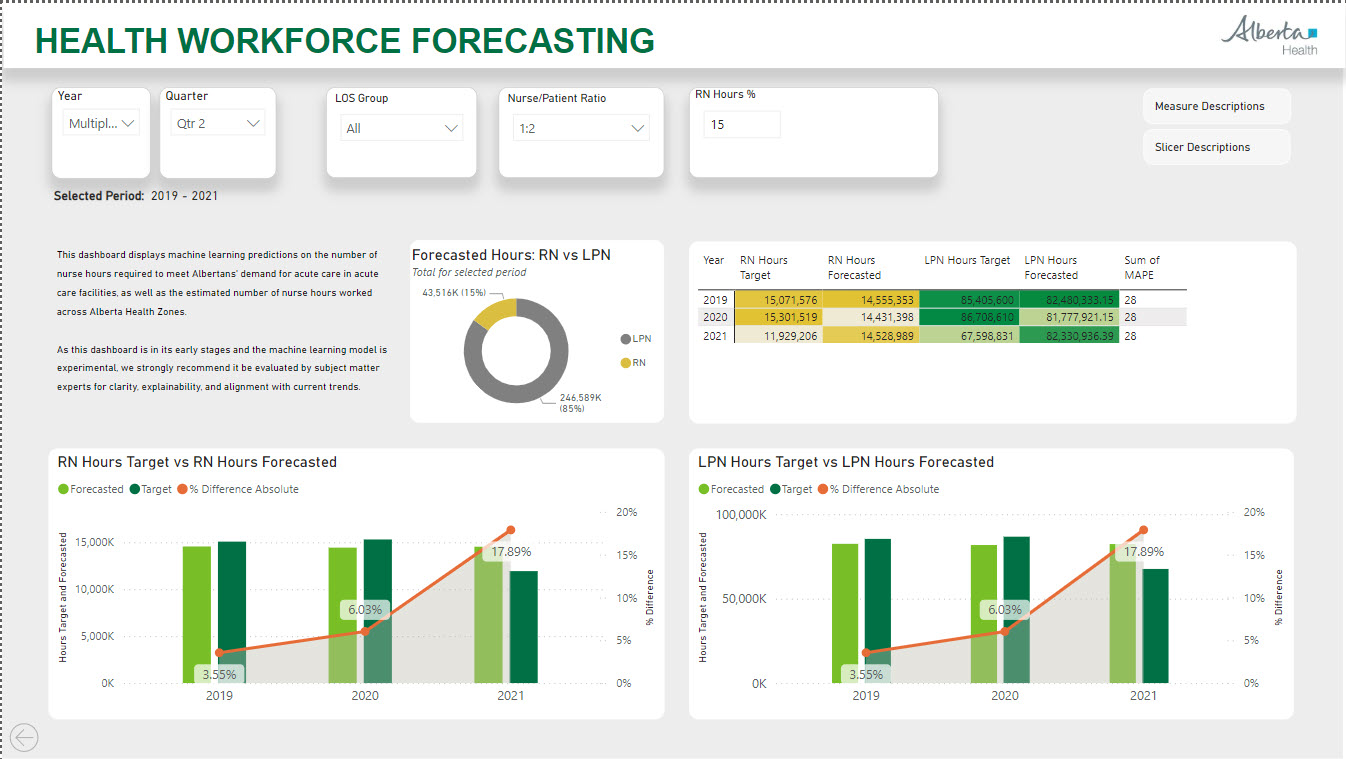
Rather than projecting nursing demand directly from historical staffing data, the model predicts patient length of stay across acute care facilities. From there, it estimates the care hours each patient will require from the healthcare system. Aggregate those care hours across facility types, regions, and time horizons, and you get a defensible, data-driven picture of nursing demand.
The approach is more accurate than top-down headcount projections because it accounts for how patient acuity, care complexity, and discharge patterns actually drive nursing workload. It also gives planners a model they can interrogate, adjusting inputs to see how changes in patient volume, care protocols, or discharge rates affect staffing needs downstream.
The model was designed to support both short-range operational forecasts and longer-range policy planning, giving health system leaders a single tool that serves multiple audiences.
WHY IT MATTERS
Healthcare workforce shortages aren't solved at the point of crisis. They're solved years earlier, through decisions about how many students to train, where to place graduates, and how to distribute roles across a health system. Those decisions require accurate demand forecasts.
This solution is explicitly designed to give Alberta's health planners a foundation for those decisions, one that's grounded in how patients actually move through the care system, not just how staffing has looked historically.