-
What We Do
-
AI NavigatorGain clear direction and momentum as your chart your organization’s AI path.
-
AI FoundationsEstablish the essential skills, systems, and mindset to support sustainable AI adoption.
-
Agentic AI LabExplore, prototype, and refine agent-driven solutions to accelerate real-world impact.
-
GovLabAdvance government innovation with practice AI solutions tailored to unique public sector needs.
-
-
Featured
 The AI Agent Advantage: Understanding Your Digital Workforce
-
Some Industries We Support
-
Featured
 Building Canadian Communities with Homegrown AI


Insights
The AI Agent Advantage: Understanding Your Digital Workforce
In this 3-part series, “The AI Agent Advantage”, we’re not just talking about theories; we’re showing you how to build a high-performing digital workforce that delivers real results. In Part 1, we cut through the hype and explain exactly what AI agents are and how these digital team members are built to take on the daily grind, freeing up your team for more important work.
The Productivity Paradox: Why We’re Stuck
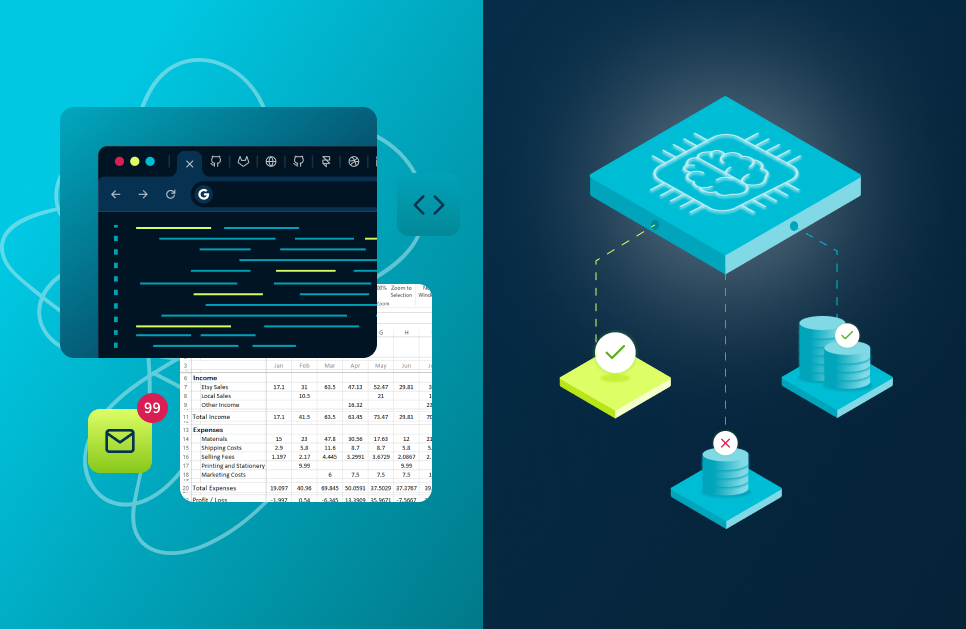
Picture this. It’s Monday, 9 a.m. You’ve already got 17 tabs open, and your inbox? A black hole. You’re cross-referencing a spreadsheet of sales numbers against live inventory levels in another system. You’re toggling to yet another system to update client profiles manually. Every click, every copy-paste feels like a micro-interruption that drains your focus and eats away at the hours you should be doing high-impact work. Instead, you’re trapped doing digital gruntwork.
Sounds like a replay of your day? You’re not alone! This is the Generative AI (GenAI) Paradox. Almost 80% of companies have adopted GenAI. And yet, an equal number have reported no significant impact on their bottom line. Where’s the disconnect? Companies have gravitated toward general-purpose, “horizontal”, copilot (GPT-like) applications that deliver unclear productivity gains. Meanwhile, “vertical” applications, purpose-built to transform processes, remain trapped in pilot purgatory. We’ve unlocked powerful AI, but we’re still finding ourselves stuck in the weeds.
So, why aren’t we applying AI where it could make the biggest difference? It boils down to a critical factor: reliability. A creative AI chatbot is great for brainstorming ideas, but when it comes down to running your business, you can’t risk deploying technology that might “hallucinate” facts or mess up tasks. The stakes are too high. What if you had to pause operations because of an unpredictable AI? Complete non-starter. This lack of trust is what often keeps game-changing AI from getting off the ground.
The real challenge isn’t just access to powerful AI, but deploying it reliably within your unique workflows. Enter AI agents. They’re not just smarter chatbots or digital assistants. They’re an entirely new kind of software: autonomous, goal-driven digital team members. Think of them as designed to really understand your objectives and proactively handle complex, multi-step tasks for you.
Beyond the Prompt: What Defines an AI Agent?
AI agents aren’t just a minor upgrade. They’re in a whole different league than the GenAI models everyone’s now familiar with. Think of it as the difference between having a tool that simply gives you information versus a digital worker that can actually take initiative and act on its own. It’s a fundamental shift.
The Core Distinction: From Analyst to Team Member
Access to powerful AI models is no longer a challenge (i.e. knowledge on demand). An LLM is like a world-class consultant or a brilliant, siloed researcher. It can produce a detailed analysis with superhuman speed and eloquence, but its work ends when the document is delivered. It’s a brain in a vat, capable of incredible feats of reasoning, but unable to proactively take action.
An AI agent, by contrast, is an empowered digital team member who takes that same strategic analysis and turns it into action. It doesn’t just deliver a report; it completes the entire, multi-step workflow. For example, a data analyst agent doesn’t simply analyze a spreadsheet. It takes that analysis a step further by automatically querying live inventory levels from your database and updating records, all without requiring you to lift a finger. The LLM provides the core “brain”, but the agent offers the digital hands and feet to execute tasks in the real world.
This action is the fundamental shift. It’s the difference between a tool like Copilot, which recommends the next line of code, and an agentic system like Cursor (although Copilot has followed closely behind the success of tools like Cursor), which can independently edit, create, update, and execute files. It’s not just a smarter chatbot; rather, a specialized team member designed to take initiative and drive outcomes for a specific function.
The Three Pillars of Agency
To enable their powerful, autonomous capabilities, AI agents operate upon three foundational pillars that differentiate them from any AI that has come before. Together, these pillars are what transform a passive text generator into an active digital worker.
- Pillar 1: Autonomy
Autonomy is the most defining characteristic of an AI agent. Unlike a digital assistant or chatbot that waits for your next command, an agent receives an objective and figures out how to execute it on its own. It’s not simply a tool you actively wield, but a team member you could eventually delegate complex responsibilities to. We’re getting to a point where an agent can manage entire workflows, not just individual tasks. Imagine delegating that frustrating Monday morning grind to a background agent so you can focus on high-impact work. That’s truly game-changing. - Pillar 2: Reasoning and Planning
An AI agent doesn’t just follow a rigid, pre-programmed script. Instead, it uses one or multiple LLMs as its powerful reasoning engine. It understands the big-picture goal and then breaks it down through “task decomposition.” It breaks down complex objectives into a series of logical, step-by-step (or even simultaneous) subtasks, creating a game plan. This ability to perform dynamic planning is why agents are well-suited to handle irregular, multi-step problems that simple, rule-based systems can’t. They can size up a situation, weigh different options, and choose the best course of action based on what they know. Plus, these subtasks can even be handled by other sub-agents working together. - Pillar 3: Tool Use
Reasoning and planning create the game plan to solve a problem, but tool use is what makes the strategy actionable. Agents don’t just generate text; they can perceive and interact with their digital environments using a set of “actuators” or tools. For a trucking company, an agent could connect to APIs, internal databases, and fleet management software to optimize routes. This ability to use tools enables an agent to read new specifications from a file, query parts of a database for availability, send a maintenance alert to a vehicle, or update an estimation record. This interaction with the broader software ecosystem enables an agent to execute its plan to make real changes within your operations.
What’s Next for Your Digital Workforce?
We’ve explored how AI agents represent a fundamental shift, moving beyond simple GenAI to become autonomous, goal-driven digital team members. Core capabilities (autonomy, reasoning and planning, and tool use) empower agents to take initiative and drive outcomes in ways previous AI models could not. In our next post, we’ll look at the “autonomy of a digital worker” to understand how AI agents can think and act intelligently within your business.