-
What We Do
-
AI NavigatorGain clear direction and momentum as your chart your organization’s AI path.
-
AI FoundationsEstablish the essential skills, systems, and mindset to support sustainable AI adoption.
-
Agentic AI LabExplore, prototype, and refine agent-driven solutions to accelerate real-world impact.
-
GovLabAdvance government innovation with practice AI solutions tailored to unique public sector needs.
-
-
Featured
 The AI Agent Advantage: Understanding Your Digital Workforce
-
Some Industries We Support
-
Featured
 Building Canadian Communities with Homegrown AI


The AI Transformation Breakthrough Your Org Chart Needs
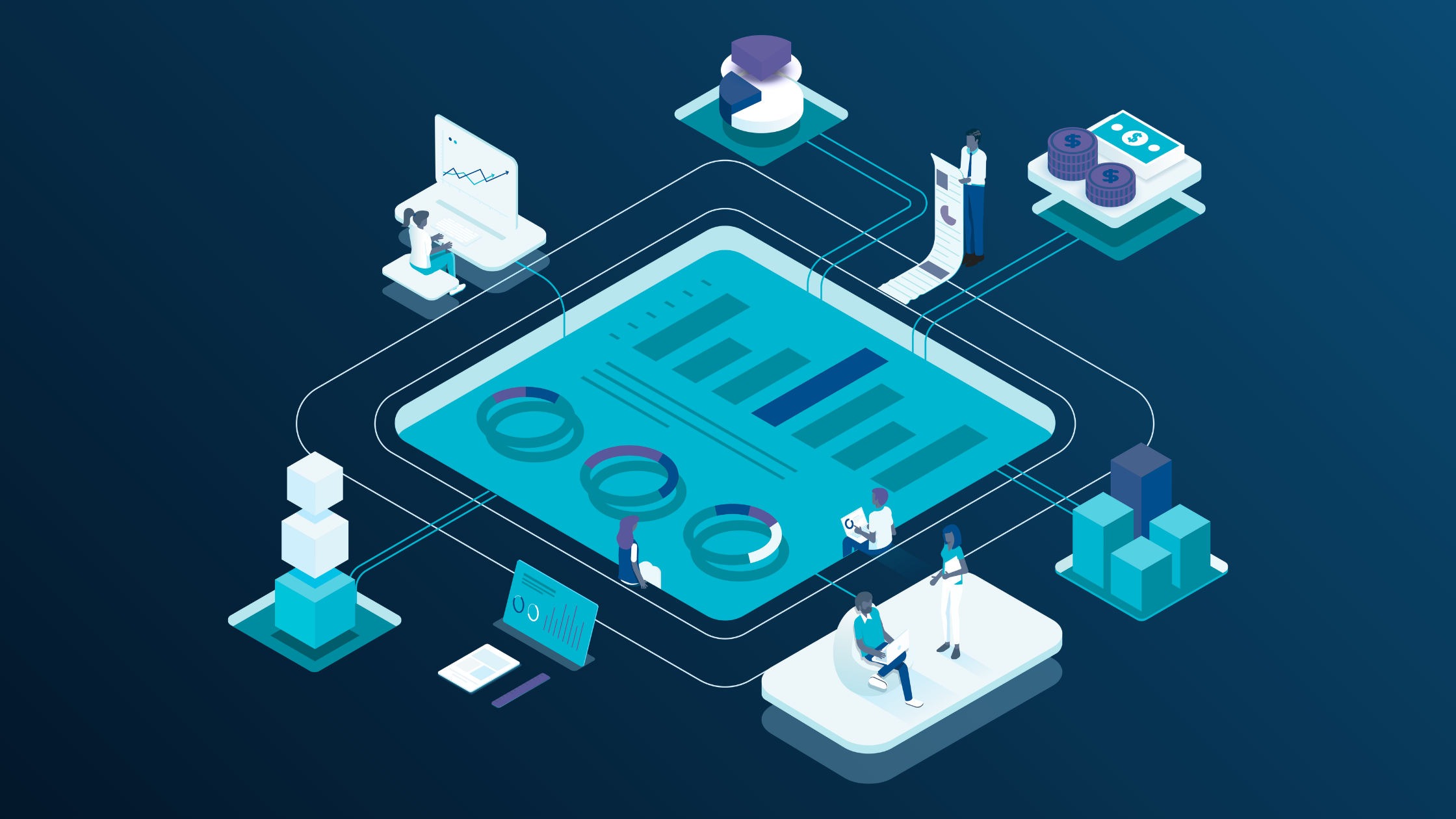
As AI integration deepens, the organization redesigns itself around it.
Most companies think about AI adoption as a rollout. Buy the tool, train the team, measure the productivity lift. That framing misses the bigger shift underway.
AI transformation happens in phases, and each phase changes the shape of the organization itself. What starts as individual tools becomes shared infrastructure. What starts as personal productivity becomes organizational speed. By the final phase, the org chart looks different, not just the workflows inside it.
Here’s how we see it play out.
Phase 1: Individual Augmentation
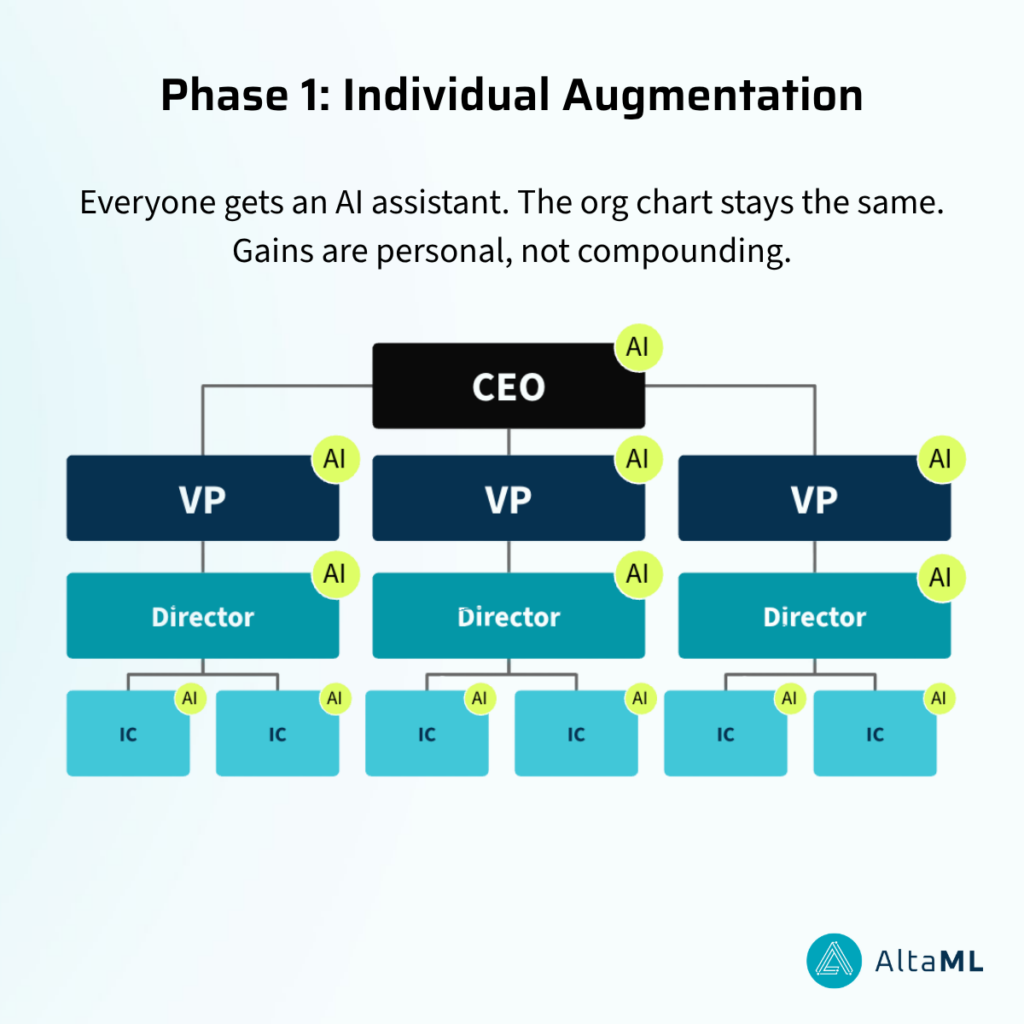
In this phase, everyone gets an AI assistant. The org chart doesn’t change. CEO, VP, director, individual contributor: the reporting lines stay exactly where they were.
Every employee has access to AI, whether that’s Claude Cowork or a similar assistant. Each person becomes individually more productive.
The gains are real, but they don’t compound. One director’s faster report writing doesn’t make the whole department significantly faster. One IC’s quicker research doesn’t change how the team works together. The organization has more AI and some individuals can produce more, but teams don’t yet work any differently.
Phase 2: Department Workflows
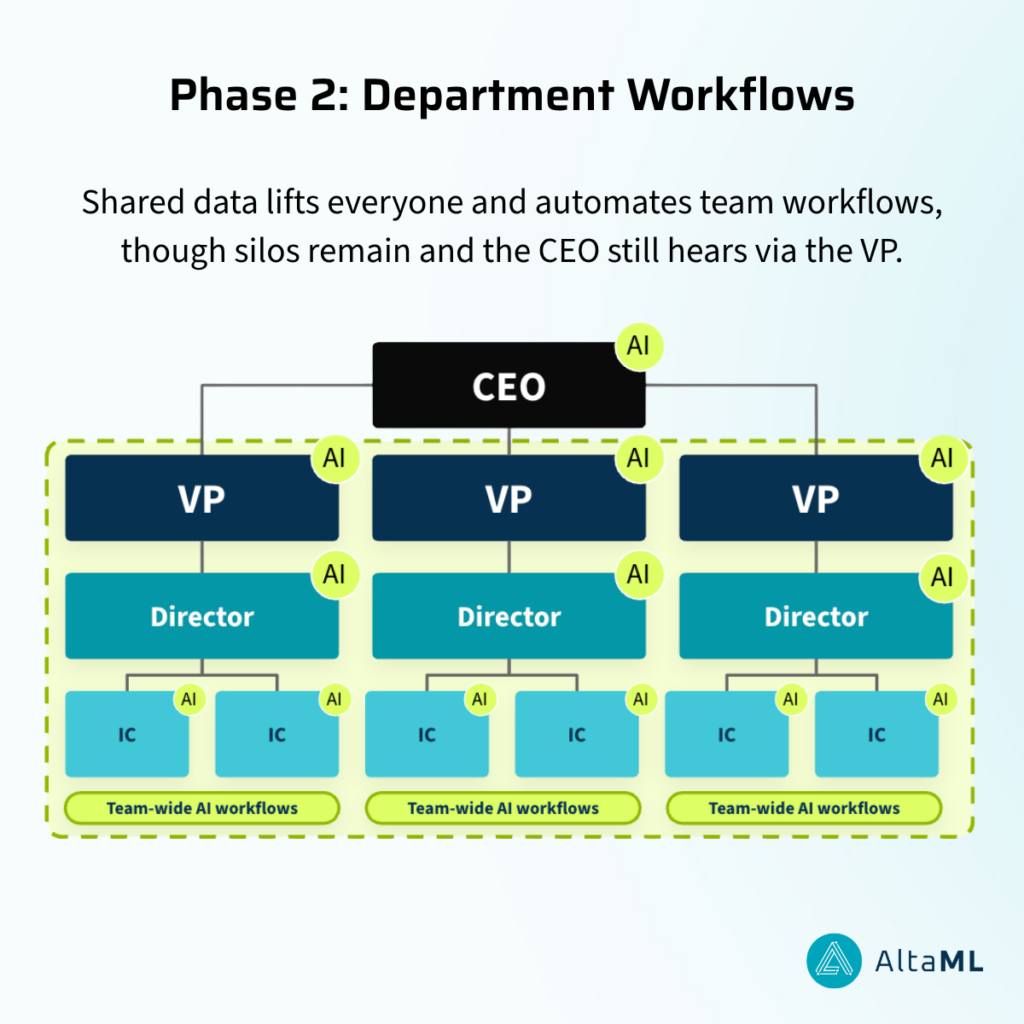
In the second phase, the unit of change shifts from the person to the team.
Departments start sharing data. That shared data lifts everyone in the department at once, not just the people using AI the most. Team workflows get automated: demand forecasting, reporting, routine coordination.
This is where “AI+” starts to mean something. A department with shared context and automated workflows moves faster than the sum of its individually augmented employees.
But the silos remain. The CEO still hears about progress through the VP or department lead, the same way they always have. Information still moves up the chain one layer at a time. What’s changed is how fast and how well each layer moves on its own.
Phase 3: Org-Wide AI-Native
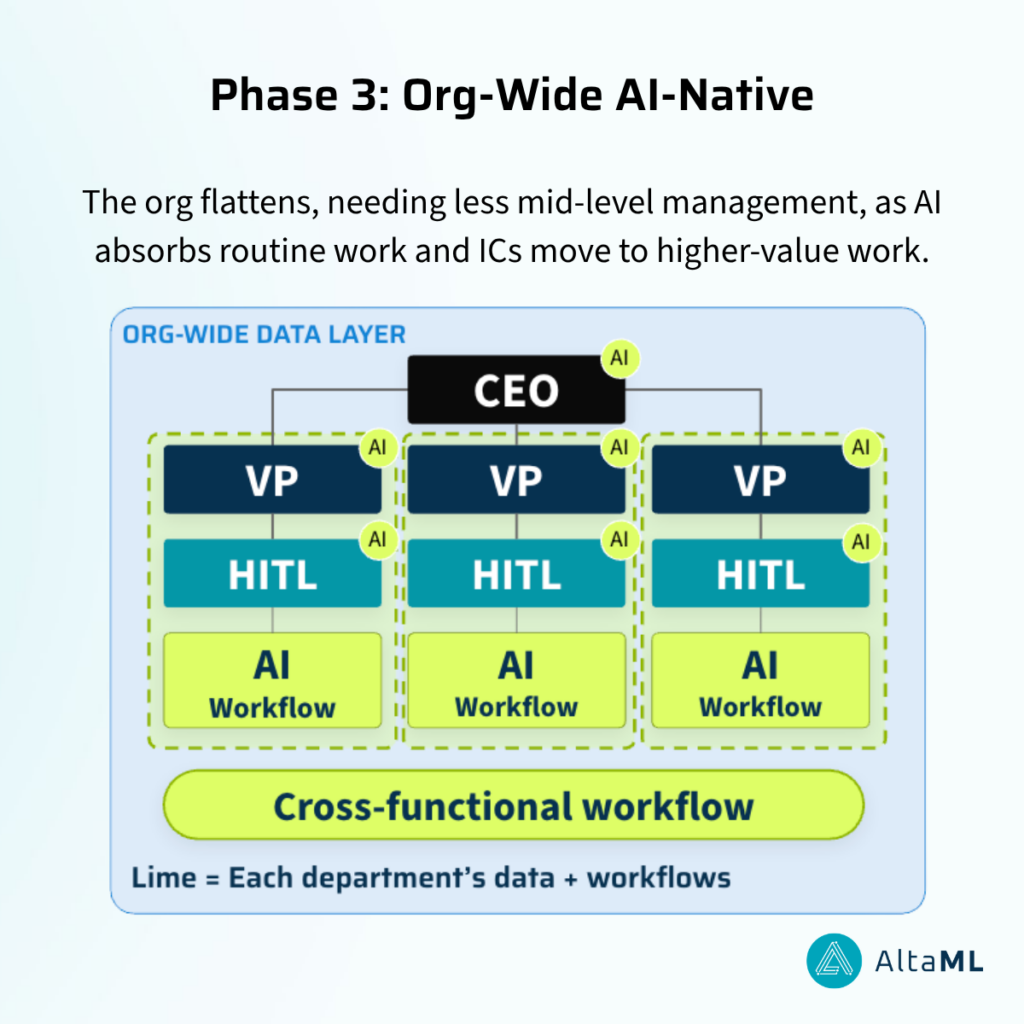
The third phase is where the structure itself changes.
The organization flattens. Mid-level management, built originally to coordinate and relay information, becomes less necessary as AI absorbs the routine coordination work. Former individual contributors move into higher-value roles, closer to judgment calls and away from repetitive tasks.
Cross-functional workflows span departments instead of stopping at their edges. Data that used to live in one team’s systems becomes part of an org-wide layer, and workflows built on top of it don’t care which department they cross.
The clearest signal of this phase is what the CEO sees. For example, instead of quarterly reports built manually in spreadsheets two weeks after the quarter closes, an automated order-to-cash workflow can produce financial visibility on demand. The decision-making isn’t just faster. It’s structurally different: real-time instead of retrospective.
What This Means at the Department Level
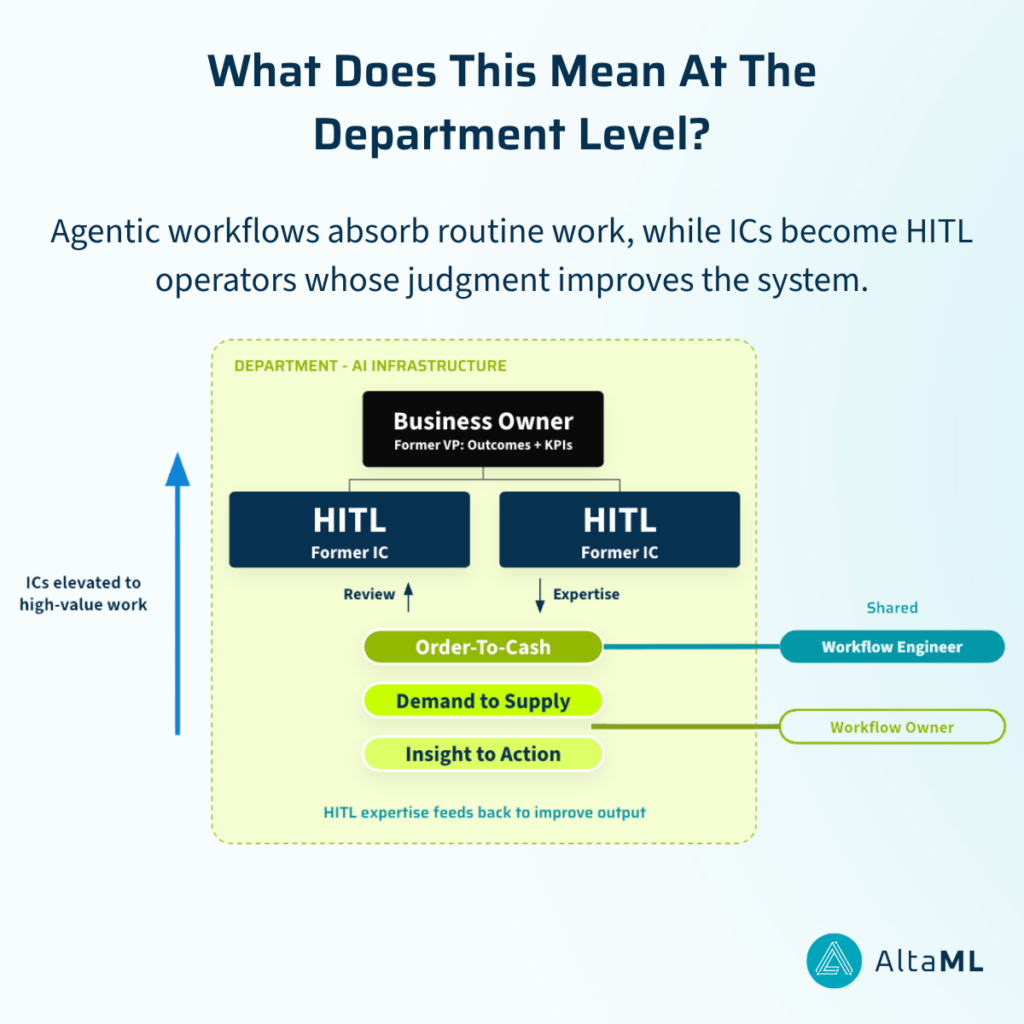
Zoom into any one department in Phase 3, and the shift becomes concrete.
Agentic workflows take over the routine, high-volume work: the transactions, the repetitive steps, the tasks with clear rules. That doesn’t eliminate the people who used to do that work. It moves them.
Former individual contributors become human-in-the-loop, or HITL, operators. Their job is no longer to execute the routine work themselves. It’s to handle exceptions, apply judgment where the workflow can’t, and bring domain expertise that AI doesn’t have. That expertise feeds back into the workflows, which keeps improving the Agentic system over time.
Two roles emerge to build and run this system. A workflow engineer maintains the shared platform underneath every department’s workflows, the infrastructure layer everyone draws on. A workflow owner designs and owns each specific workflow, whether that’s order-to-cash, demand-to-supply, or insight-to-action, making sure it reflects how the business actually needs to run.
The result is a department where the business owner, formerly a VP focused on outcomes and KPIs, oversees a small team of HITL experts instead of a traditional hierarchy of directors and reports. Teams have greater productivity and decisions are made on real-time high quality data.
The Throughline
Across all three phases, one idea holds: AI transformation isn’t something that happens to an org chart. It’s something that eventually redraws it.
Phase 1 proves individual value. Phase 2 proves team value. Phase 3 proves that value can move across the whole organization, in real time, without waiting for it to climb the ladder one layer at a time.
The companies that get this right aren’t the ones with the most AI tools. They’re the ones willing to let their structure change as the work changes underneath it.