Skip to content
Making Decades of Equipment Data Searchable

Making decades of equipment
data searchable in seconds

For a major international oil company, every hour of turnaround downtime costs $90,000. The problem? Engineers couldn't find
the  answers fast enough in their sea of existing data to make good decisions. AltaML built a multimodal AI solution that turned their
fragmented records into real-time answers, with estimated downtime savings of up to $42.6M.

Hard Hat
CLIENT

A leading international
oil and gas company

machinery
PROJECT
Multimodal AI search for equipment data across shutdown, turnaround, and outage operations
data-sorting
WHAT WE DID

AI development, language and image-based search, document processing, and integration across structured and unstructured data sources

stopwatch-fast
IMPACT

Search time per request dropped from 1–4 hours to approximately 1 minute, with $42.6M in downtime savings
THE CHALLENGE

Shutdown, turnaround, and outage (STO) events are among the most complex operations in oil and gas. Hundreds of contractors, engineers, and inspectors converge on a facility, racing to complete maintenance, inspections, and repairs before a deadline measured in dollars per hour. And at $90,000 per hour of downtime, the cost of a slow decision is immediate and concrete.

To make matters more complicated, equipment histories, inspection reports, regulatory documents, SAP notifications, and maintenance logs existed across dozens of systems in dozens of formats. Some were structured. Many weren't. Handwritten inspection notes, scanned images, legacy PDFs. All technically available, all practically inaccessible at the speed turnarounds demand.

An engineer trying to understand the history of a specific piece of equipment before making a repair decision could spend up to four hours searching. Equipment Strategy (ES) tasks that required pulling historical data took two full days of search time out of a five-day process. With hundreds of repair requests per turnaround and thousands of ES tasks per year, that overhead added up fast.

The result: delayed decisions, inconsistent risk assessments, and the recurring loss of institutional knowledge every time a contractor or long-tenured employee moved on.

Oil Refinery

THE SOLUTION

AltaML built an STO Advisor — a multimodal AI search engine that makes the company's full body of equipment data accessible through a single interface.

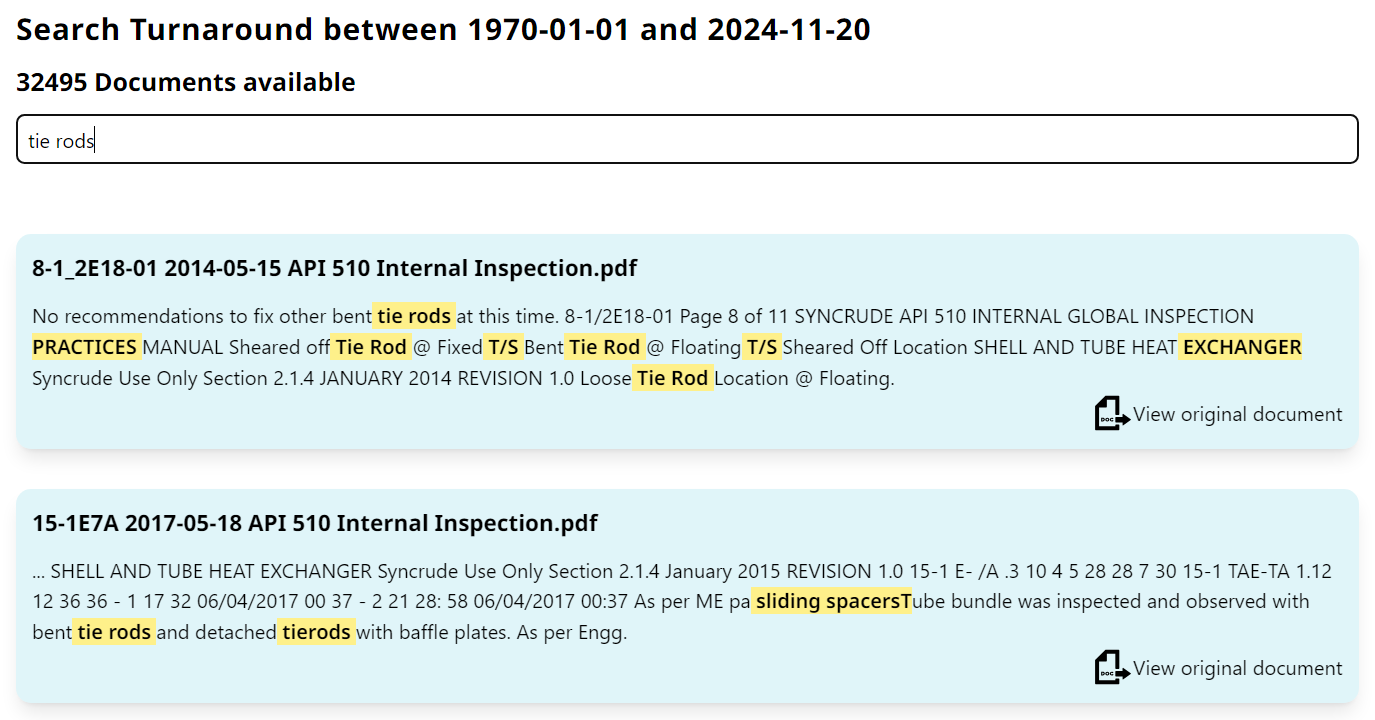
The system integrates inspection reports, regulatory documents (including PESTRA compliance records), SAP notifications, worklists, equipment tasks, and historical images. Using a combination of computer vision, NLP, and LLMs, it handles queries across both structured and unstructured sources, including image-based searches that let engineers find similar past issues visually, not just by keyword.

THE CORE CAPABILITIES:

document-correct
Document search and summarization
Engineers enter a natural-language query and get targeted results from across the full document corpus, with summaries and linked source documents.
calendar
Chronological equipment histories
The system automatically links related records across time, giving engineers a consolidated history of any piece of equipment on demand.
computer-vision
Image search
Engineers can search by image to find visually similar past issues, surfacing relevant precedents that text search alone would miss.
shield-checkmark
Compliance access
Regulatory documents and compliance records are surfaced alongside operational data, so engineers aren't switching between systems to check requirements.
99.6% Reduction in QA and engineering search time, from 1-4 hours down to 1 minute.
42.6 M in estimated downtime savings, based on 485 hours of avoided downtime at $90,000 per hour of recoverable production value.
98% Reduction in Equipment Strategy tasks, from two days of data retrieval to 15 minutes.

WHY IT MATTERS

Every oil and gas company running STOs has this data. Inspection reports, maintenance histories, compliance records — it exists. The problem is that it lives in formats, systems, and locations that make it functionally unavailable at the speed real decisions require.

Beyond the numbers, advisors and accelerators like ForgeAsk address a risk that doesn't show up in downtime calculations: the loss of institutional knowledge when experienced engineers and contractors move on. By centralizing decades of equipment history in a searchable system, it ensures that expertise stays in the organization, not just in the people who built it.

STO Advisor

THIS IS WHAT AI LOOKS LIKE WHEN IT'S ACTUALLY IN USE ON THE FLOOR.

See more of how we build for energy operations, or talk to our team. We'd love to hear about what you're trying to solve.