Finding the Fireproofing Failures that
Visual Inspections Miss
A large oil sands operation was spending $4.8 million a year on manual fireproofing inspections that were inconsistent, expensive,
and had already let a 15-pound slab fall 20 feet. AltaML and Kleinfelder built a computer vision system that detects cracks and
deterioration from 3D LIDAR scans, cutting $1.2 million in annual costs and reducing falling debris incidents to zero.
A large oil sands operation
Computer vision model development, custom inspection dashboard, geotagged anomaly reporting
$1.2M in annual cost savings, 25% reduction in inspection hours (32,000 to 24,600 per year), and zero falling debris incidents
THE CHALLENGE
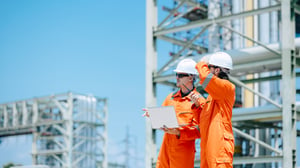
Fireproofing protects refinery steel from fire damage, and in a large oil sands operation with dozens of plants, the cost can run into the tens of millions. Protecting that investment means sending inspection teams through every square meter, twice a year, looking for deterioration by eye. The problems with that approach compound over time. Manual visual inspections are expensive, inconsistent from one inspector to the next, and dependent on conditions that make the work difficult: outdoor inspections in -40C weather, walking active plant sites, closing off sections of the facility while the inspection team works through.
A process that depends entirely on human observation under difficult conditions has a structural reliability ceiling — and that ceiling is one that more inspectors or more frequent inspections simply cannot raise.
In 2018, that ceiling became visible for this large oilsands operation. A 15-pound piece of fireproofing fell 20 feet at one of their plants. No one was struck, but the potential for a fatality was real. The incident triggered a formal review of the operation's fireproofing management strategy and a decision to find a fundamentally different approach.
THE SOLUTION
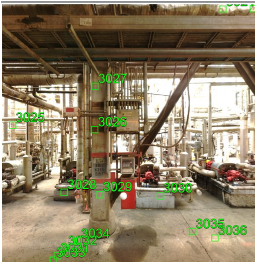
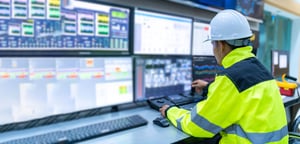
AltaML and engineering firm Kleinfelder developed a three-phase solution that moved the inspection process from the plant floor to a remote workstation.
AltaML trained a computer vision model on the tagged data. Experts identified deficiencies in sample images and the model learned to recognize those characteristics and began detecting them in new scans. When the model identifies a deficiency, it automatically generates a work order for fireproofing repair.
Inspectors review the model's predictions. Their validations feed back into the model, improving its accuracy over time.
This is all delivered through a custom dashboard that allows the team to initiate crack detection, validate model predictions, view crack density on facility maps, and generate geotagged reports that give repair vendors precise instructions.
savings
Incidents
WHY IT MATTERS
Visual inspection is not a precision instrument. It is a human process applied to a physical problem at scale, and it has the limitations that come with that. In a plant environment, those limitations have consequences: a missed deterioration indicator is not an abstract quality metric, it is a slab of material that falls.
The case for automated inspection in industrial settings is not primarily about cost, though the cost case is significant. It is about replacing a process that has a structural accuracy ceiling with one that improves over time. Manual inspection at this scale asks something no process can reliably deliver: consistent accuracy across tens of thousands of data points, in harsh conditions, year after year.