-
What We Do
-
AI NavigatorGain clear direction and momentum as your chart your organization’s AI path.
-
AI FoundationsEstablish the essential skills, systems, and mindset to support sustainable AI adoption.
-
Agentic AI LabExplore, prototype, and refine agent-driven solutions to accelerate real-world impact.
-
GovLabAdvance government innovation with practice AI solutions tailored to unique public sector needs.
-
-
Featured
 The AI Agent Advantage: Understanding Your Digital Workforce
-
Some Industries We Support
-
Featured
 Building Canadian Communities with Homegrown AI


Insights
The AI Agent Advantage: From Theory to Application
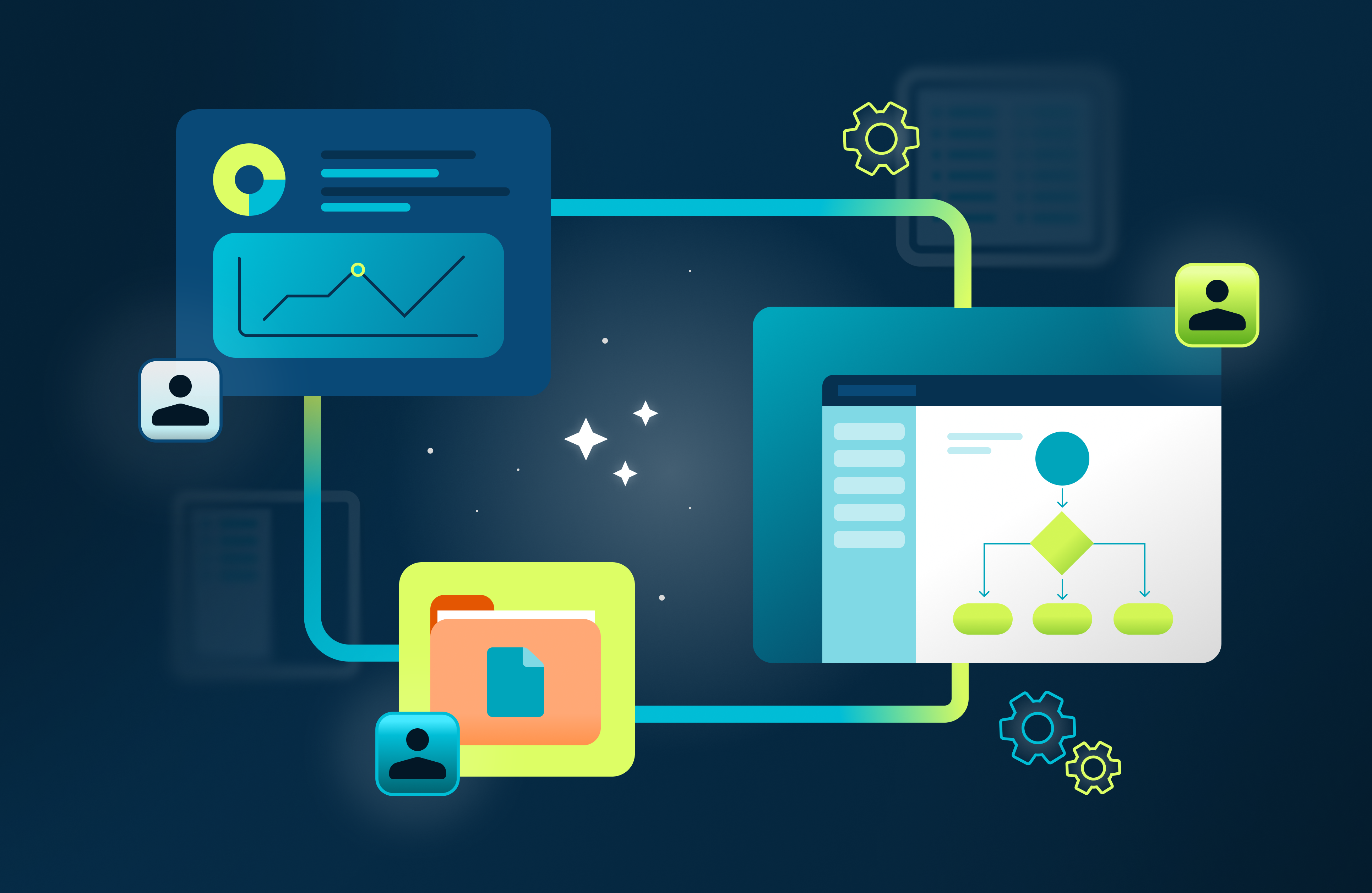
In the first two parts of The AI Agent Advantage series, we explored what AI agents are and the way they think and act. Now, to understand their value, you need to consider what they can do for your business. This post moves from theory to application by profiling specific, high-impact jobs these digital workers can take on for you today.
Meet Your New Digital Team Members
What’s an AI agent archetype? Think of it as a job description for an AI. Just like you’d hire an accounting manager, graphic designer, or data analyst for a specific role, you can “hire” an AI agent to do a specialized job. In the examples below, we’ll introduce you to some common archetypes, explain how they can take ownership of high-value tasks on your team, and show you the real-world business value they deliver.
Archetype 1: The Corporate Librarian
This agent specializes in finding and summarizing information from your company documents. It’s like a research expert that can instantly search through all of your files, from legal archives and compliance manuals to engineering specs and internal reports. It reads, understands, and provides precise, synthesized answers based on your private data.
How It Works: When you ask a question, using Retrieval-Augmented Generation (RAG), the agent searches your documents for relevant information. It then uses its LLM to generate a clear and accurate response based only on those sources. It provides a citation back to the original document, so you can always verify the information and build trust, a necessity for high-stakes work.
Business Value: The Corporate Librarian drastically reduces the time spent on manual research. It provides everyone instant access to institutional knowledge that was previously siloed, ensuring decisions are based on consistent, accurate information. It’s an invaluable asset for legal, compliance, R&D, and strategic planning teams.
Archetype 2: The On-Demand Data Scientist
This agent turns any business user into a data analyst. It’s a force multiplier for data analysis, enabling anyone—from marketers to operations managers—to ask simple, natural language questions and receive immediate answers from structured data, such as spreadsheets and databases.
How It Works: Ask a question in plain English, like “Can you show me the year-over-year sales growth for our top five products in Europe?”. The agent uses its reasoning capabilities to understand your needs, writes the necessary code (typically Python or SQL queries) to perform the analysis, and executes the code in a secure, sandboxed environment to provide you with the answer. It then presents the findings back to you in the most suitable format, such as a data table, summary, or even a visual chart or graph.
Advanced Capability Spotlight: The most advanced agents can handle tricky or vague questions. If you ask, “How is interest in our new car evolving?”, the agent will recognize the ambiguity (terms like “interest” or “evolving”) and either make an intelligent, documented assumption (e.g., “Assuming ‘interest’ means ‘total units sold’ and you’d like to compare this year-to-date against last year…”) or ask you to clarify. This helps prevent misinterpretations and ensures you get the correct data the first time.
Business Value: This agent breaks down data silos and removes the bottleneck of relying on a small data science team for routine analytical tasks. It accelerates data-driven decision-making across every department, fostering a more agile and informed business culture.
Archetype 3: The Automation Specialist
This AI agent is your tireless back-office workhorse. It’s designed for high-volume, repetitive tasks that require some level of intelligence, like processing thousands of invoices, extracting information from reports, or validating insurance claims against policy rules. It handles the digital gruntwork so your team doesn’t have to.
How It Works: The Automation Specialist operates asynchronously, pulling tasks from the processing queue and applying a pipeline of predefined intelligent tools. It can “read” documents, extract key data fields, and apply business rules for validation. A critical confidence-scoring mechanism flags any item that requires a human review. This human-in-the-loop (HITL) design is essential because it blends the speed of automation with the quality and judgment of human oversight.
Business Value: This agent delivers enormous operational efficiency, significantly reduces processing costs, and minimizes human error in tedious tasks. It frees up human experts to focus their valuable time on complex or high-risk exceptions, dramatically increasing their leverage and impact.
Archetype 4: The Intelligence Briefer
This AI agent automates the tedious process of creating structured, long-form documents such as weekly performance reports, project status updates, and competitive intelligence briefings. It acts as a master coordinator of information.
How It Works: The Intelligence Briefer starts with a report template. It then collaborates with other systems and AI agents, to gather the necessary components. For example, it could tell a data analyst agent to create a sales trend chart, ask a Corporate Librarian agent for a summary of industry news, and pull key metrics from a financial database. Once all the pieces are collected, they are assembled into a polished and consistently formatted ready-to-read document.
Business Value: This agent saves leadership and operational teams countless hours of manual data gathering and report creation. It ensures that critical business reporting is consistent, on time, and, most importantly, allows your team to focus on analyzing insights and making strategic decisions rather than getting bogged down in the mechanics of report creation.
The Blueprint for a High-Performing Digital Workforce
You can’t build a high-performing human team by just hiring a few people and hoping for the best. The same is true for a digital workforce. Deploying AI agents that deliver real value requires a strategic, disciplined approach. Success comes from a foundation of quality, trust, usability, and a commitment to continuous improvement.
The following four principles form a blueprint for building enterprise-grade agentic systems that you can trust with mission-critical processes. They communicate a simple idea: AI isn’t a product you buy; it’s a capability you engineer.
Principle 1: Intelligence Begins with Impeccable Data/Context
You’ve probably heard the old saying, “Garbage in, garbage out.” It’s never been truer than with AI. An agent can only reason and act correctly if the data it works with is of high quality. Feeding it poorly structured, incomplete, or irrelevant information is the fastest way to get inaccurate answers and “hallucinations”.
Building an enterprise-grade AI system requires a common-sense approach to how data is processed. Beyond just putting all your documents in one place, you need to ensure the AI understands the context of the information. For instance, when processing a legal document, the agent needs to know that a specific clause belongs to a particular section. Without that full context, the agent could misinterpret the information and provide dangerously incorrect answers. Ultimately, the quality of an agent’s output is a direct result of the quality of its data.
Principle 2: Trust is Built on Transparency and Measurement
Delegating critical processes to an AI agent requires a significant leap of faith. This trust isn’t automatic; it has to be earned through rigorous validation and transparency. A “black box” solution, no matter how powerful, will never be trusted with mission-critical work. That’s why every successful agentic system needs a clear, transparent way to show how it’s performing.
Before deploying an agent, you need to define what constitutes good performance, setting clear and measurable goals. These key performance indicators (KPIs) may include metrics like response accuracy, task completion rates, or reduced processing times. These metrics should be continuously monitored on a dashboard, providing everyone with a clear view into the agent’s performance, its limitations, and the return on investment (ROI) it delivers. After all, you can’t manage what you can’t measure.
Principle 3: Adoption Hinges on Human-Centric Design
The most powerful AI system is useless if it’s too complicated to use. Many AI projects fail not because of the technology itself, but because people are unwilling to use it.
That’s why a great user experience (UX) is critical, not an afterthought. An AI agent’s user interface and its seamless integration into your existing workflows are core to its success. The goal is to make interacting with these digital workers feel as natural and easy as collaborating with a human colleague. This boosts productivity and satisfaction rather than adding more work. The “last mile” of any AI implementation is the human interface, and a human-centric design is critical for unlocking the full potential of your digital workforce.
Principle 4: The Best Systems are Designed to Learn
The business world is constantly changing. An AI agent that can’t improve quickly becomes obsolete. AI should not be viewed as a static product. It’s a living, evolving system with a built-in engineering for continuous improvement. These four principles argue that enterprise-grade AI isn’t an off-the-shelf product. It’s a holistic capability that requires careful engineering. This blueprint offers a clear mental model for vetting potential AI partners, providing business leaders with a checklist for achieving true excellence that goes beyond a flashy demo.
Your Digital Workforce Starts Now
As we wrap up this 3-part series, it’s clear: the era of AI as a novelty is over. AI agents aren’t just tools; they’re a digital workforce. They are a practical and powerful way to embed intelligence directly into your business, capable of taking ownership of entire roles with speed, accuracy, and autonomy.
The goal is not to replace human talent. The goal is to elevate and augment it. By delegating complex, repetitive tasks to a reliable digital workforce, you free your team to focus on uniquely human skills, like high-level strategy, creativity, complex problem-solving, and building deep relationships. This human-agent partnership is the direct path to supercharging productivity and unlocking innovation.
Seize the AI Agent Advantage
Building an effective digital workforce is a strategic journey, and that requires a clear vision for reimagining work and a partner with the expertise to design, build, and manage reliable, scalable solutions. It requires deep, full-stack expertise. At AltaML, we’ve tackled over 400 use cases and partnered with more than 100 clients to turn AI concepts into real-world solutions. We’ve mastered the art of getting AI into production. Let’s discuss how you can unlock your AI advantage and lead the future of work.